


Serving Western North Carolina Since 1994 Get A confidential Consultation
-
“David Teddy was more than worth the money... he actually took the time to listen.”
- Rosslyn S. -
“David Teddy and his team are outstanding!!! WORTH EVERY PENNY!”
- Nicholas D. -
“Ralph is the epitome of what a lawyer should be.”
- Melinda R. -
“Daniel Talbert is a top-notch attorney... he has a never-give-up approach even when things look bleak.”
- Roger T.

Legal Custody and Physical Custody in North Carolina
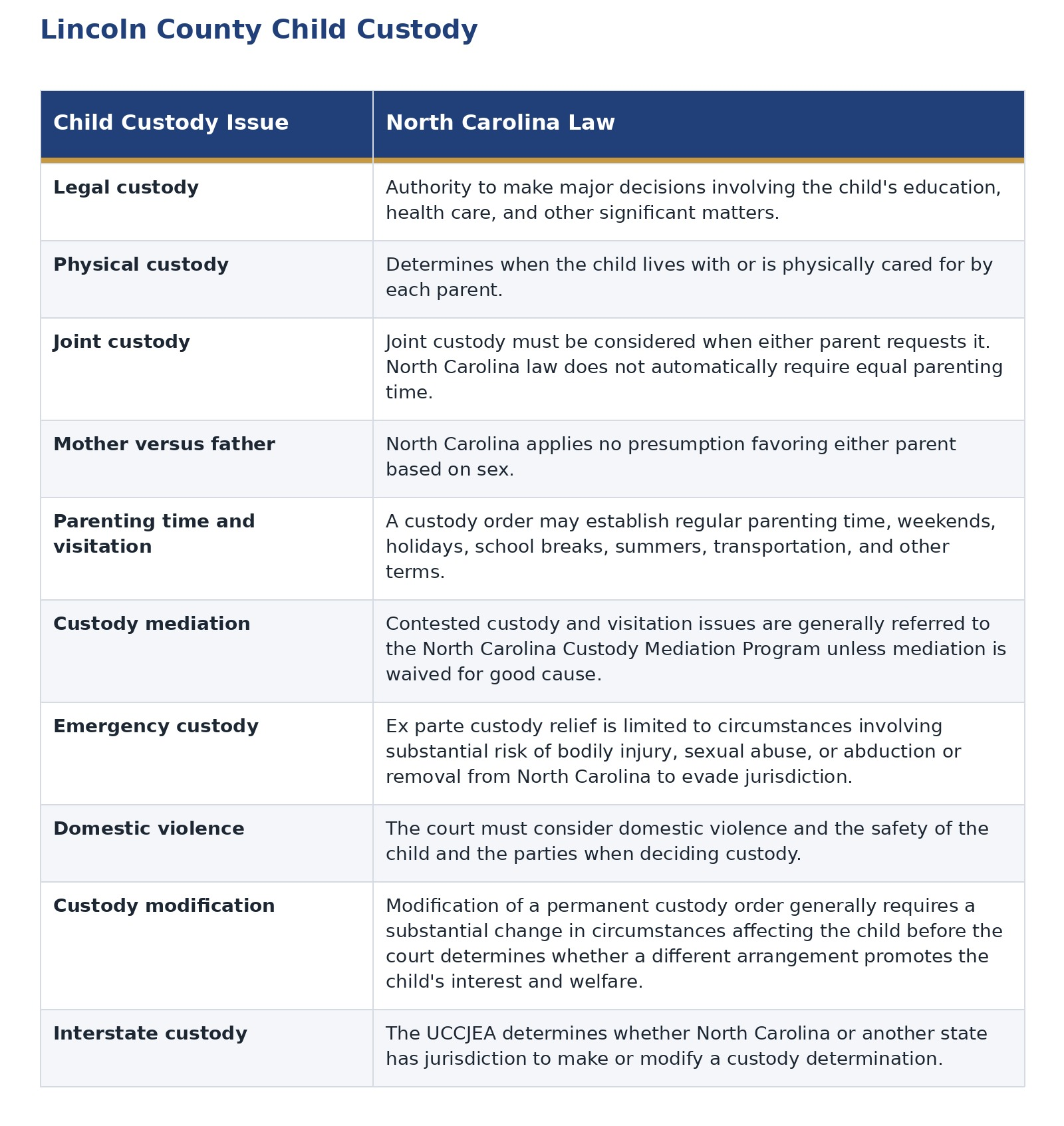
North Carolina custody orders and parenting agreements commonly address legal custody and physical custody separately.
Legal custody involves decision-making authority. A parent with sole legal custody may have authority to make major decisions without obtaining the other parent's agreement. When parents share joint legal custody, the order may require them to consult and make significant decisions together. Some orders divide final decision-making authority by subject or establish a process for resolving disagreement.
Physical custody concerns when the child is actually in each parent's care. A child might live primarily with one parent while spending scheduled visitation and parenting time with the other. Other families divide physical custody more evenly. The words used in an order matter less than the actual rights, responsibilities, schedules, and decision-making authority set out in the document.
Joint legal custody does not necessarily mean equal physical custody. Likewise, a parent who has less parenting time does not necessarily lose meaningful decision-making authority.
When no custody order exists, legal parents generally have equal rights concerning the child. Parents who agree on custody do not need a custody order, although the lack of an enforceable order can matter if an informal arrangement stops working.


-
“David Teddy was more than worth the money... he actually took the time to listen.” - Rosslyn S.
-
“David Teddy and his team are outstanding!!! WORTH EVERY PENNY!” - Nicholas D.
-
“Ralph is the epitome of what a lawyer should be.” - Melinda R.
-
“Daniel Talbert is a top-notch attorney... he has a never-give-up approach even when things look bleak.” - Roger T.
Child Custody | Lincoln County District Court
When parents cannot agree, a District Court judge decides custody based on the child's interest and welfare after considering all relevant evidence. North Carolina law specifically requires consideration of domestic violence, the safety of the child, and the safety of either party from domestic violence by the other party. The resulting custody order must contain findings supporting the court's decision.
There is no statutory checklist assigning mathematical weight to each fact. The evidence instead needs to explain the child's actual circumstances.
A custody hearing may involve evidence concerning the history of daily parenting, stability of the child's home and school schedule, medical or therapeutic needs, each parent's work schedule, transportation, communication between the parents, substance abuse, domestic violence, significant changes in the child's life, and each parent's ability to meet the child's needs.
Evidence about the breakdown of the parents' relationship may have limited value when it does not relate to parenting or the child. Custody court is not a referendum on which parent was the better spouse. The legal inquiry concerns the child.
North Carolina also does not establish an age at which a child simply chooses where to live. A judge may consider the preference of a child who has sufficient maturity and judgment, but the child's preference does not bind the court.
Joint Custody Does Not Automatically Mean Equal Parenting Time
North Carolina law does not say that joint custody is automatically preferred whenever parents can get along. N.C.G.S. § 50-13.2 sets forth that joint custody shall be considered upon the request of either parent. That is different from creating a presumption that joint custody must be awarded.
North Carolina public policy encourages child-centered parenting arrangements and continued participation by both parents when that promotes the child's welfare. That policy remains subject to the circumstances of the particular child, including domestic violence, substance abuse, mental health concerns, and other relevant evidence.
A custody order therefore might provide joint legal custody with one parent having primary physical custody. It might provide substantial physical custody to both parents. In another case, the evidence may support sole legal custody, sole physical custody, supervised visitation, restricted contact, or another arrangement.
Labels alone do not decide the case.
Custody Mediation in Lincoln County
Emergency Child Custody in North Carolina
Emergency custody has a much narrower legal meaning than an urgent disagreement between parents.
Consistent with N.C.G.S. § 50-13.5(d)(3), a court (the Family Court Judge) cannot enter an ex parte temporary custody order changing a child's living arrangements before service or notice unless the court finds one of the statutory circumstances. The child must face a substantial risk of bodily injury, a substantial risk of sexual abuse, or a substantial risk of abduction or removal from North Carolina for the purpose of evading the jurisdiction of North Carolina courts.
That standard is intentionally strict. A disagreement about school, parenting style, missed visitation, disrespectful communication, nonpayment of alimony, or a parent's belief that the existing schedule is unfair does not automatically satisfy the emergency custody statute.
There is also a separate concept of temporary emergency jurisdiction under North Carolina's UCCJEA when a child is present in this state and has been abandoned, or emergency protection is necessary because the child, a sibling, or a parent has been subjected to or threatened with mistreatment or abuse.
The legal basis for emergency jurisdiction and an ex parte change in custody can depend on the specifics of the case.
Temporary and Permanent Child Custody Orders
Child custody orders may be temporary or permanent, and that classification can affect what must later be proven to change the arrangement.
A temporary custody order remains legally binding while it is in effect. It may establish where the child lives, parenting time, decision-making authority, exchanges, communication, or other custody terms while the case remains pending.
A permanent custody order carries a different modification standard. A party seeking to change a permanent custody order generally must establish a substantial change in circumstances affecting the child before the court reaches whether modification would promote the child's interest and welfare.
The word “temporary” in the title is not always the only consideration in determining the legal character of an order. When modification becomes an issue, the actual order, procedural history, and later court activity need to be reviewed.
Modifying a Child Custody Order in Lincoln County
Children grow. School schedules change. Parents relocate. Jobs change. Health issues develop. A parenting schedule that worked several years ago may stop fitting the child's circumstances.
Those facts do not automatically permit modification of a permanent custody order.
North Carolina law requires a party seeking modification to establish a substantial change in circumstances affecting the child's welfare. If that threshold is met, the court then determines whether modifying custody promotes the child's interest and welfare. North Carolina appellate law recognizes that the relevant change does not have to be harmful in every case. A change that benefits or is likely to benefit the child can also support modification when the legal requirements are satisfied.
That makes the connection between the changed circumstances and the child especially important. A parent's new job, remarriage, relocation, improved housing, deteriorating communication, or changed preference does not operate in isolation. The court examines how the change affects the child and the existing custody arrangement.
Custody enforcement is a separate issue. If the problem is violation of the existing order rather than changed circumstances, the appropriate legal proceeding may involve enforcement or contempt rather than modification.
Moving & Relocation | Child Custody in North Carolina
Relocation and moving out of state custody cases can present both practical and legal problems because distance can affect school attendance, transportation, weekday parenting time, extracurricular activities, holidays, and the child's relationship with each parent.
A parent's move does not automatically require a custody modification. When a permanent custody order already exists, the legal question is generally whether circumstances have changed substantially in a manner affecting the child and, if so, whether a different custody arrangement promotes the child's interest and welfare.
Domestic violence creates an important statutory protection. When a party is absent or relocates with or without the children because of an act of domestic violence, N.C.G.S. § 50-13.2 provides that the absence or relocation cannot be weighed against that party in determining custody or visitation.
A proposed move outside North Carolina can also raise jurisdiction and enforcement questions under the UCCJEA.
Interstate Child Custody | UCCJEA
A Lincoln County address does not necessarily mean a North Carolina judge has authority to make the first custody determination.
North Carolina follows the Uniform Child-Custody Jurisdiction and Enforcement Act, commonly called the UCCJEA. For an initial custody determination, North Carolina generally looks first to the child's “home state” when the proceeding begins, or to the state where the child has lived for the preceding six months while a parent or qualifying caregiver remains here. Other jurisdictional bases apply when no state qualifies under the primary home-state rule or when another state declines jurisdiction.
Physical presence in North Carolina alone is neither necessary nor sufficient to establish ordinary initial custody jurisdiction.
Interstate cases become more complicated when another state already entered a custody order. A state that properly made the earlier determination may retain exclusive continuing jurisdiction. North Carolina generally cannot simply replace another state's custody order because the child later moves here.
Domestic Violence in North Carolina
Domestic violence is clearly a very important aspect of child custody issues in North Carolina law.
N.C.G.S. § 50-13.2 requires the Court to consider acts of domestic violence, the safety of the child, and the safety of either party from domestic violence by the other party. When the court finds domestic violence occurred, the custody terms must protect the children and the party who was a victim of domestic violence, consistent with Chapter 50B.
A civil Domestic Violence Protective Order under Chapter 50B can include temporary custody provisions. A separate Chapter 50 custody action may also exist or later be filed.
Those proceedings are civil. A criminal charge for domestic violence arising from the same alleged conduct is a separate case with different procedures and legal consequences.
Evidence concerning domestic violence therefore may affect more than one proceeding without making those proceedings legally identical.
Child Custody and Child Support | Separate Legal Issues
Custody and child support can affect one another, but they are technically separate legal issues.
The custody schedule and number of overnights may affect the child support calculation under the North Carolina Child Support Guidelines. That does not mean a parent can stop paying court-ordered support because the other parent has denied parenting time. It also does not mean payment of support creates additional custody rights.
When an existing court order governs either issue, informal agreements between the parents can sometimes create practical problems if the court order itself is never modified or formally adopted by the Judge as binding.
Attorney Meredith Shuford | Lincoln County Family Law Background
Meredith Shuford grew up in Lincoln County and graduated from Lincolnton High School. Before taking the bench, she practiced law in Lincolnton for ten years with her father, Thomas M. Shuford Jr., and Robert Lewis. During part of that practice, she served as a Guardian ad Litem Attorney Advocate representing children alleged to have been abused or neglected.
Meredith then served fourteen years as a District Court judge in Lincoln and Cleveland Counties. Her judicial work included numerous family law matters involving families and children in custody, child support, spousal support, and property division. She also obtained certification as a Juvenile Court Judge in 2012 following additional training involving child development, substance abuse, and domestic violence.
After leaving the bench, Meredith returned to private practice in the community where she grew up and raised her family.
Prior service as a District Court judge does not promise a particular result and does not provide special access to the court. It does provide a professional background that includes years of reading custody pleadings, hearing evidence, making findings, and entering orders in family cases.
Lincoln County Family Law | Child Custody Lawyer
A custody dispute may begin with a disagreement about a schedule, but the legal case can expand quickly into questions about jurisdiction, mediation, emergency relief, domestic violence, relocation, decision-making authority, enforcement, or modification of an older order.
Meredith Shuford represents clients in child custody and other family law matters throughout Lincoln County. The Teddy, Meekins & Talbert Law Firm may be available to review existing custody orders and pleadings, identify the issues currently before the court, and explain the available legal options. Call now to schedule a confidential consultation 704-396-5155